
Products
Fresh chilli and peppers from East Africa

Welcome to Correct Agri Ltd.
Fresh chilli and peppers
Spicy peppers contain the substance capsaicin, which causes the familiar "spicy" or "hot" sensation by activating nerve cells in the mouth. The spiciness varies greatly between pepper varieties and is measured using the Scoville scale.
Capsaicin originated as a natural insect repellent and is used worldwide as a seasoning in various cuisines, including Asian and Mexican.
Correct Agri Ltd exports different types of fresh chili and Peppers i.e.
• Jalapenos
• Cayenne pepper
• Rawit chili
• Habanero pepper
• Carolina Red Pepper
• Madame Jeannette Pepper
• Naga Jolokia Pepper
• Pimiento de Patron Pepper
• Shishito Pepper
• Poblano Pepper


What makes a pepper spicy?
• Capsaicin: This is the substance in peppers that causes the sensation of heat and pain.
• Location of capsaicin: The concentration of capsaicin is mainly in the seeds and membranes of the
pepper. Removing these makes a pepper milder.
• The Scoville scale: This scale is used to rate and compare the spiciness of peppers.
Identification and characteristics:
• Various shapes and colors: Just like bell peppers, chili peppers come in many different shapes,
sizes, and colors.
• Origin: Chili peppers are native to Central and South America and were brought to Europe by European
explorers in the 16th century.
• Growing: Chili peppers grow on a plant and can be grown at home, in a greenhouse, or on a patio.
Uses and Effects:
• Flavoring: Chili peppers are used worldwide to add spice and aroma to dishes.
• Health Benefits: Capsaicin can have anti-inflammatory properties, improve blood circulation, and
release endorphins (happiness hormones).
• Food Preparation: They can be used fresh, dried and ground into chili powder, or frozen to enjoy
their flavor year-round.

Our Range Of Chilli and Peppers
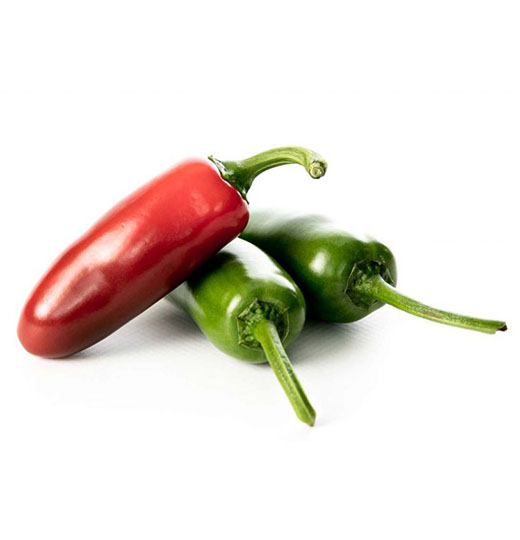
JALAPEÑO-PEPPERS
Sharpness between mild and spicy:
Because the jalapeño pepper is known for being slightly milder (but beware: it's still spicy), its uses are wide-ranging. It can be used whole or in halves in dishes. It's also excellent for stuffing. It pairs perfectly with guacamole.
Fruit info: The peppers are 4 to 7 centimeters long, with a shiny skin and a cone shape
Packaging options: Packaged in 50, 75, 250, and 500 gram packages and loose in 1 or 2 kg packages
Available Year Round
CAYENNE-PEPPERS
De iets mildere PEPPERSoort:
The pepper is slightly less hot once the seeds are removed. Cayenne pepper is a popular ingredient in many recipes. It's often used in Spanish recipes and is also a great starting point if you want to make your own sambal.
Fruit info: The Cayenne pepper is long and shiny, with the longer peppers slightly curved.
It grows to 7 to 18 centimeters long and 0.5 to 1.5 centimeters wide, and has an average fruit weight of 2
to 5 grams.
Packaging options: Packaged in 50, 75, 250, and 500 gram packages and loose in 1 or 3 kg packages
Available Year Round


RAWIT-PEPPERS
Favoriet in de Thaise en Indonesische keuken:
The Rawit pepper is a small one, but certainly not mild. It's much spicier than its size suggests. Rawit is widely used in Asian cuisine. These very hot peppers are used in sambals and salsas, as well as stir-fries and curries. They are also called Bird's-eye, Piri-Piri, or Thai Chili and are available in red and green.
Fruit info: The Rawit pepper grows to 3 to 8 centimeters in length and has a diameter of 0.1 to 0.3
centimeters.
The average fruit weight is 2 to 10 grams.
Packaging options: Packaged in 50, 75, and 100 gram packages and loose per 2 kg packages
Available Year Round
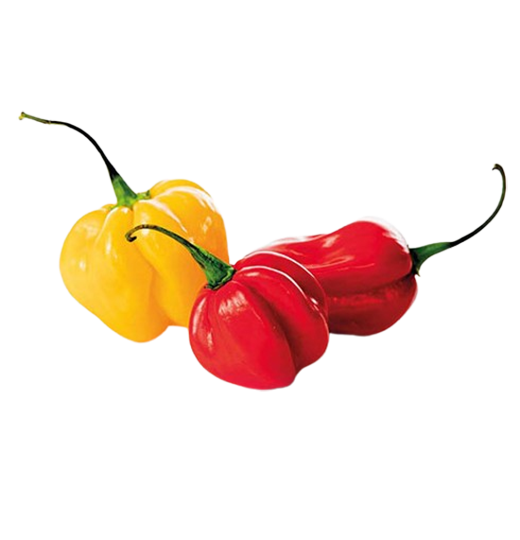
HABANERO-PEPPERS
Outside category in the pepper range:
The habanero pepper is a robust pepper with beautiful, vibrant red and yellow hues. With a Scoville index of 100,000 to 350,000, these spicy chili peppers are among the hottest in the world. Habanero peppers are best used in curries, stews, or spicy stir-fries.
Fruit info: The Habanero most resembles a lantern. There are green, yellow, orange, and red
varieties, which are no larger than 3 to 6 centimeters.
Packaging options: Packaged in 50, 75, 250, and 500 gram packages and loose per 1 to 2 kg packages
Available Year Round
CAROLINA REAPER-PEPPERS
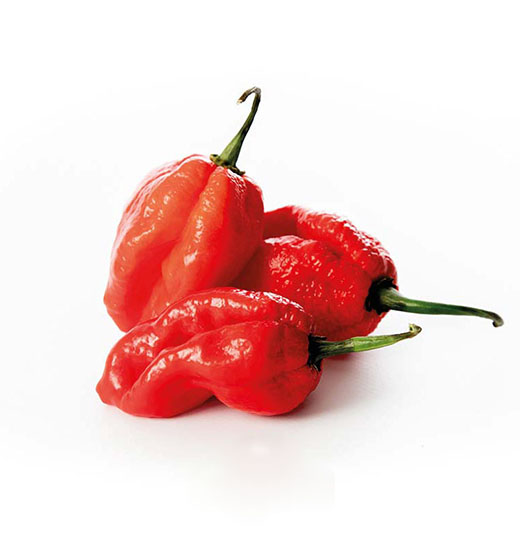
The Carolina Reaper is the hottest chili pepper in the world. These extremely hot peppers are characterized by their beautiful red color and wrinkled skin. The tip of this hot pepper is also called the "scorpion tail" and resembles a wasp's stinger.
Fruit info: There are green and red varieties, which are no larger than 3 to 6 centimeters..
Packaging options: Packaged in 50, 75, and 100 gram packages and loose per 2 kg packages
Available Year Round
MADAME JEANETTE-PEPPERS
Qua uiterlijk lijken op kleine, verfrommelde paprika's of kleine belPEPPERS:
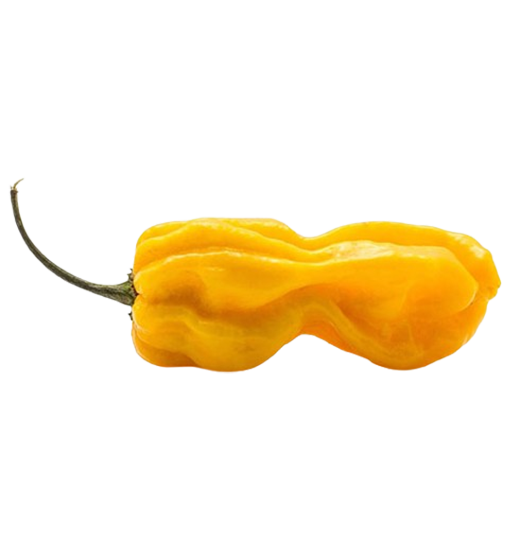
Originally from Suriname: Madame Jeanette. A yellow chili pepper. This pepper is very hot. It was likely named after a woman from Paramaribo who passionately practiced the oldest profession in the world. The flavor is slightly fruity, reminiscent of mango and pineapple.
Fruit info: There are yellow and red varieties, Madame Jeanette Shape point Fruit size 10 x 2.5 cm
Fruit weight 20 grams.
Packaging options: Packaged in 50, 75, 250, and 500 gram packages and loose per 1 to 2 kg packages
Available Year Round
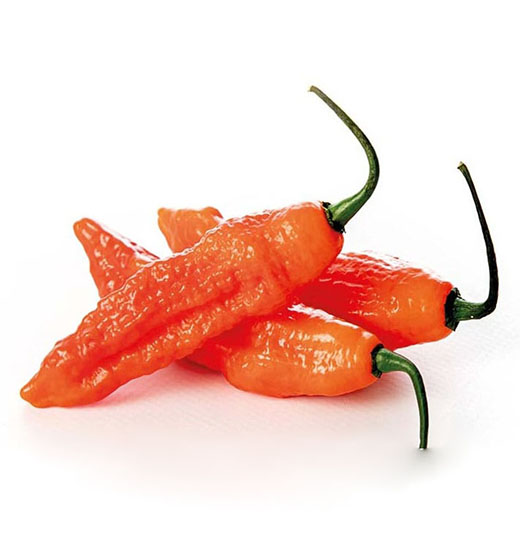
NAGA JOLOKIA-PEPPERS
The skin is slightly wrinkled, and the shape is most reminiscent of a miniature bell pepper.
The Naga Jolokia was once declared the hottest pepper in the world. Other peppers have since taken its place. The Naga Jolokia originated in India. A bite of this pepper is comparable to the bite of a king cobra. "Naga" is therefore the Assamese translation for "king cobra" (the region in India where the pepper originates). The pepper has an orange, red, or brown color and a rough skin.
Fruit info: The size is modest, with a length of 5 to 8 centimeters and a diameter of 2 to 3
centimeters.
Packaging options: Packaged in 50, 75, and 100 gram packages and loose per 1 to 2 kg packages
Available Year Round
PIMIENTOS DE PADRÓN-PEPPERS
De PEPPERS danken hun naam aan het dorpje Padrón in de regio Galicië in Spanje:
Pimientos de Padrón are small, green Spanish peppers from Galicia known for their mild, sweet flavor, but with a surprising twist: some are hot. They are often sautéed in olive oil and sprinkled with sea salt as a tapas snack, lightly charring the skin and softening the flesh.
Fruit info: This mild chilli pepper is only available as a green chilli pepper and has a length of
3 to 8 cm, a diameter of 1 to 2 cm and weighs 6 to 10 g.
Packaging options: Packaged in 50, 75, and 100 gram packages and loose per 1 to 2 kg packages
Available Year Round


SHISHITO-PEPPERS
The Shishito pepper is a Japanese chili pepper and, like a Spanish churro, is ribbed lengthwise with a relatively thin skin. The Shishito tastes more like paprika than pepper, perhaps a bit spicier. This pepper is harvested young. The base of the pepper resembles a lion's head, hence the name Shishito (a reference in Japanese).
Fruit info: The Shishito is approximately 9 cm long, 1 to 2 centimeters in diameter, and weighs 6
to 10 grams.
Packaging options: Packaged per 200 grams and loose per 2 kg packages
Available Year Round
POBLANO-PEPPERS
Paprika-like pepper, also in spiciness:
As a pepper of Mexican origin, the Poblano is a true flavor enhancer in many Mexican dishes. Its size also makes it a suitable stuffing pepper. Its mildly spicy flavor makes the Poblano perfectly edible. Stuffed with spicy ground meat, it's an easy-to-prepare delicacy.
Fruit info: The Poblano has a length of about 9 centimeters, a diameter of 3 to 5 centimeters and a
fruit weight of 60 to 80 grams.
Packaging options: Packaged per 200 grams and loose per 2 kg packages
Available Year Round
